07 June 2006

Scene from a Sidewalk Cafe, Tuesday Evening

SCENE: Two young folks sit at a table outside a mom-and-pop coffee house, just before sundown. He’s sipping a China Black, and she’s drinking grape juice and eating dried fruit and cottage cheese. Their conversation turns from vaguely political and spiritual topics to the more practical matter of what they should do with the rest of the evening…

HE: Well, we could just go home and watch those Marx Brothers movies. They’re due back on Friday, so we need to watch them sometime soon.
SHE: Maybe. I don’t know, though…I don’t think I could really focus on a movie right now. Although, shit, I do want to see The Omen. Is that out yet?
HE: Yeah, it opened today. You didn’t think they were gonna miss this date, did you? I think the only reason they decided to remake the movie at all was so they could release it on 6/6/6.
SHE: I forgot that today was 6/6/6. The apocalypse is supposed to be tonight.
HE: Oh, right. (pause) Well, then, I guess we don’t have to worry about getting the Marx Brothers movies back on time. You wanna go to The Omen?
SHE: No. Not really. I guess we could just wander around…
HE: Yeah, we’re pretty good at that.

[a motorcycle roars past, obscuring her response. She gazes after it with loathing]

SHE: I want a Tommy gun.
HE: I’ll get you one for your birthday.
SHE: No, better not. If I had one, I’d use it.
HE: I’ll get you a paintball gun instead.
SHE: We don’t need a gun anyway. We could just stand along the sidewalk with, I don’t know, a crowbar or something, and when a motorcycle passed us we could jam the crowbar into the spokes.
HE: (grins) Oh, evil girl. (brightens) Hey, it’s 6/6/6!
SHE: I know. We were just talking about it.
HE: Right. We need to go out and do something evil in commemoration of the day.
SHE: Evil? Like sacrificing babies?
HE: Well, maybe not that evil. Just something fun. Something cheerfully, randomly, celebratorially evil.
SHE: What did you have in mind?
HE: I don’t…I don’t know, off the top of my head. Couldn’t we just walk around until evil came over us? You know, searching for inspiration? Just ‘til we ran across a kitten we could drown or something?
SHE: You know, now I’m not sure wandering around is such a good idea tonight. I’m not wearing good wandering shoes.
HE: Oh. Well, any ideas?
SHE: None.
HE: Our evil production has fallen well below quota recently. (lost in thought, gazing around) I’ve got it!
SHE: What?
HE: I’m gonna go over to that newspaper machine, and I’m only gonna put in 50 cents, but I’m gonna take TWO newspapers.
SHE: (with a tolerant smile) Oooh, that IS evil.
HE: In fact, I’m gonna take EVERY newspaper in the box! How’s that for evil, baby?
SHE: That’s about as evil as it gets.

[she rolls her eyes and shakes her head as he wanders off, stage right, only to return sheepishly a few seconds later, empty-handed]

HE: Damned thing’s empty.
SHE: Yeah, that kinda thing doesn’t work so well at 9:00. We should’ve done it first thing this morning, and hit every newspaper box in town, so that no one could have their paper.
HE: Well, next time, we’ll know.

[She speaks, but stops and stares with even more hatred than before as another, even louder, motorcycle passes]

HE: WHAT?!?!?
SHE: Automatic weapons!
HE: Noisy.
SHE: I’m serious. We need, I don’t know, submachine guns or something.
HE: Yes, but with silencers.
SHE: Oh, of course. They’re very loud.
HE: And we’ll go around very quietly killing noisy people. We’ll be the Noise Pollution Killin’ Bandits.
SHE: That sounds like a good name for a band.
HE: Yeah, and we’ll play on street corners, but if people throw change into our hat we’ll shoot ‘em, ‘cause the jingling makes us crazy.
SHE: And we’ll play electric guitars but they won’t be plugged into anything, ‘cause we hate the noise…and instead of singing, we’ll whisper the songs.
HE: And I’ll play my saxophone, only with socks stuffed down into the bell so it won’t make any sound.
SHE: I didn’t know you could play the saxophone.
HE: With socks down the bell, neither will anyone else.
SHE: And with the money we make from our music, we’ll buy automatic weapons and kill bikers.
HE: Now, THAT’S evil. There’s our next evil project.
SHE: No, it isn’t evil, really. I mean, they kinda deserve it, making all that noise. It’s justified.
HE: Retributive.
SHE: They asked for it.
HE: Performing a service really.
SHE: Plus, we can’t start that tonight, ‘cause we don’t have the guns yet. We need something evil for tonight.
HE: Let’s just get some cans of spray paint and exercise our artistic impulses while committing the evil act of vandalizing.
SHE: I don’t know. I think I want to break something.
HE: Well, we’re in a town full of glass.
SHE: True. (thinks for a moment) If you were in a riot, I mean if you were living in a city and there was rioting, would you be a vandal, or a looter?
HE: Hmmm….that’s a tough one. I’d probably be happy vandalizing, really. Looters get caught too easy, ‘cause they’ve got the evidence on them, right? Plus, I live in a fucking closet, and I don’t know where I could put the loot.
SHE: Yes, I suppose we don’t want to be too materialistic.
HE: Plus, I don’t really need anything. Except I need a toaster. I’d loot a toaster, and then I’d go about vandalizing, I think.
SHE: Yeah, you can’t just go out looting at random. You’ve gotta look for things you really need.
HE: Right. I’m looking forward to being in a riot with you. Everybody else will take to the streets, and we’ll be sitting on the balcony with a legal pad saying, “Okay, we’ve gotta hit K-Mart, ‘cause I need some new bath towels,” or...
SHE: …or “Don’t forget the drug store”…
HE: …or “Hey, better grab some smokes”…
SHE: …or “What do you think is the best route from Latta’s to the liquor store?”
HE: Oh, yes, better plan the route carefully. Gotta be careful which streets you go down during a riot.
SHE: We’d be very organized looters.
HE: That's right. We’d have our little grocery list…
SHE: Only it would be a looting list…
HE: And money would be no object. Maybe we should start compiling it now. ‘Cause, you know, when the riot actually starts, there may not be much time.
SHE: Well, that’s something to do with the evening, but I think that’s probably for later. What are we gonna do right now?
HE: It’s too bad you can’t loot the things you really want. You can’t, for example, loot a dinner from Waffle House…
SHE: Okay, stay with me. What are we doing tonight?
HE: You wanted to break something?
SHE: Yes yes yes!!! Maybe we should go throw bricks through the windows of really posh places. And have really stupid, subliterate obscene notes attached to them... like, "You Stink!!!"
HE: We could do that. Personally, though, I was hoping to set something on fire.
SHE: Hmmm...well, instead of bricks, we could throw Molotov Cocktails.
HE: I don’t know if that’s a good idea. Me, you, a lighter, and flammable liquid…
SHE: Right. I can see it now: you light the cocktail, and then stand there staring at it, “Ohh, it’s so pretty” and then it blows up in your hand.
HE: Yeah, that’s probably out, then. Plus, you can’t attach a note to a Molotov.
SHE: We could do burn-pattern designs in people’s front yards with gasoline.
HE: I’ve never had any luck with that. I always draw things really carefully but just end up with a big round patch of fire.
SHE: Oh. Well, something else, then.

[both sit thinking for a while]

SHE: We’re really pathetic.
HE: I’m still waiting for the apocalypse to start. Plans might well prove to be superfluous anyway.
SHE: I forgot about that. Maybe it isn’t the apocalypse, though. Maybe it’s the Rapture. I wonder when it’s going to begin?
HE: It might have already happened. Done and over. I mean, if every “True Christian” on Earth suddenly disappeared, you and I might not know about it for a few days.
SHE: I don’t know. We can’t seem to manage any evil; maybe that’s a bad sign. Maybe we’ve been saved without knowing it. Maybe we’ll have to go, too.
HE: Jeez. Think of something evil, quick!

[blinding flash, both disappear]

GOD: TOO LATE!!! (maniacal laughter)

CURTAIN.

01 June 2006

Lighter Karma

Been out walkin' in the rain. Only briefly, unfortunately, 'cause the rain gave up on me not long into the walk. But that's okay. It was fun while it lasted. Leaving my house required a tricky bit of navigation, actually, because both Fourteenth and Fifteenth Streets flood when it rains this much this fast, and so of course Four-and-a-Half Alley transforms into a canal between these two great lakes. By the time I headed out, my apartment was an island in a sea of glistening glop. Now, I love splashing in puddles as much as the next guy, but I've seen what's on the ground in my little alley, and I don't want it floating past me in the dark. I waited 'til I got a little further away and found some slightly less-contaminated puddles to splash in.
I brought my favorite lighter with me. I call it the Magic Lighter, because it lights no matter what. I mean, it's a cheap-ass disposable lighter of indeterminate make and eccentric design, but it really is magical. It works when it's wet, it works when it's cold, it works in a car without rolling the windows up or in the wind when I've only got one hand free. I save it special to use in bad weather, 'cause it's the only lighter I can trust to stand up to the tempests the world occasionally throws at me.
But it's finally beginning to run out of fluid. I say "finally" because I've had it for over a year now. It's a really big lighter, you see (I mean BIG...I've never seen another one like it), and held a lot of fluid. It would, in fact, make a formidable weapon. I'm terribly depressed that it's dying on me, because I can't replace it. I can't just go to the store it originally came from and buy a new one, because it's stolen, and I have absolutely no idea where it was purchased.
Now, before you get thinkin' ill of me, I'm not really a thief. I mean, you could walk off and leave your wallet next to me on the bar and I'd chase you down and give it to you. But lighters...stealing lighters doesn't count as stealing. It just doesn't. I mean, in the first place, it's something most people do unconsciously. For a smoker, you light your smoke and then slip the lighter into your pocket in one motion. The pocketing of the lighter is part of the act of lighting the cigarette. Because of this, when I give someone a light, I usually light the cigarette for them rather than letting them actually handle it. It's a simple rule of self-smoking-preservation.
Also, I've come to subscribe to the Great Karma Lighter Wheel theory of lighter justice. See (an aside to the unitiated), there's this Great Karma Lighter Wheel that devolves lighters into and out of the possession of smokers (depending on diverse factors including merit, luck, and personal alcohol content), and this wheel has a Yin and a Yang. Yes, I know I'm mixing metaphors (or worse, unrelated concepts from two eastern religions that have nothing to do with each other), but try to come with me on this...
The Yin of the Great Karma Lighter Wheel: Anyone who fails to pay sufficient attention to prevent the theft of this object, which is probably the single most-stolen personal item in the long, dark story of humanity, does not deserve to have one anyway.
The Yang of the Great Karma Lighter Wheel: The person that you're stealing this lighter from came by it by virtue of its theft from ANOTHER person, and will steal it back from you at the first opportunity. In fact, this lighter probably belonged to you in a past life.
Because it's one of those bizarre facts of life that no one ever, in the history of the world, has actually bought a disposable lighter. I am completely at a loss, in fact, to explain how lighters get into the economy in the first place. I carry three or four lighters everywhere I go, just in case, and I've got probably fifty more in my house, and I can't remember ever taking money out of my pocket to buy one. The closest I come is that the little cigarette store I shop at, up at the corner of 20th Street and Fifth Avenue, gives away free lighters when you buy a carton of smokes. But that little place just can't, on their own, be responsible for every lighter on the market. Bill Gates himself couldn't have flooded the market with this many lighters.
I think the government's behind it. I think that the CIA decided to get everyone they could hooked on crack, and then they suddenly realized that in order to smoke crack you need a lighter, and so they hid a couple billion a year in lighter expenses in some HUD bill or something, and now they have secret lighter agents who surreptitiously leave lighters lying on bars, or slip them into the pockets of schoolchildren, all across America. No one but the government is capable of a conspiracy on this scale.
Anyway, yeah, I'm not gonna be lighter-less, 'cause my apartment's just plain lousy with lighters, but I am gonna miss this particular one. I'm glad the Great Karma Lighter Wheel dropped it on me, and let me keep it so long. Goodbye, old friend. I hope you've achieved Bic Nirvana at last.

12 May 2006

Birthday Flowers

Ah, hospitals.
I don’t much care for hospitals. I don’t suppose anyone does. I couldn’t say that I dislike them more than most folks, ‘cause I can’t read minds, but my dislike of them is pretty profound, if uninformed. I never get sick myself, you see; I have arthritis in my knees, and I occasionally get major hangovers, but outside of that I’m perfectly healthy and always have been.
What this means is that not only do I dislike hospitals, I also have a very limited experience of them, and don’t really understand how they operate. So, it was with some trepidation that, after I got off work last night, I walked down to St. Mary’s for visiting hours.
The last time I was in a hospital was when Rhonda, my former lover, had her surgery several years ago. The surgery lasted six hours, and I was a little bit frantic, constantly running out to smoke and then running back in and questioning staff members to make sure nothing had happened while I was outside.
When the surgery was done, some doctor or nurse or hospital employee of some kind came out and told me, “She’s fine, and we’re getting ready to move her up to room 819,” or whatever the room number was; I don’t remember. Anyway, he said I could go up and wait for her there. So I did, of course. And waited. And waited.
After an hour or a little more, I decided “Fuck this.” I was starting to think they’d done something with her, like I had fallen into a Robin Cook novel or something. So I thought, "Well, I’ll just search the hospital for her, then." And I did; I started where I’d last seen her and turned the hospital upside-down, basically, and I eventually found her after causing a great deal of consternation. Also, I threatened to take one of the orderlies outside and kick his ass because I didn’t like the way he was maneuvering her little trolley-bed thing. I woulda done it, too. He had a bad attitude.
I had a lot of trouble with the hospital staff over the course of Rhonda’s stay, actually. She’s a very sweet girl, and I’m sure the staff grew fond of her while she was there, but I would still bet they were glad when she left, ‘cause it meant I was going, too.
Anyway, so yeah, me and hospitals have a short but bitter history. I am alarmed by them; the obsessive cleanliness that comes alongside an inexplicable and unwholesome smell, the horrible-looking food on those mobile bookcases, the fact that they’re always cold make me a little bit uneasy, a feeling to which my natural reaction is extreme bitchiness. This, combined with the lack of trust I’m willing to place in some nobody (degree or not, if I don’t know you and believe in you, you’re a nobody) who is “caring for” someone I love, and the lack of interest I have in hiding this lack of trust, combine to make me a very difficult hospital visitor.
I reflected on all this as I started the long walk yesterday. But just as I began, the sun came out and it got warmer, and I thought of the excellent person I was going to see, and my mood lightened. I was still preoccupied, but a bit less…I don’t know. Angsty. Whatever.
I sang to myself, as I do when I walk; and I stopped by Kroger’s to buy a rose to bring along as a present. The song I was singing to myself as I stood in line to pay for the flower was Concrete Blonde’s “Happy Birthday”:

Smoking out the window
Feeling far away
News on the radio
Happy Birthday, Happy Birthday, Happy Birthday

The woman in front of me in line noticed this and, being friendly, asked, “So, who’s the lucky birthday girl?”
This, of course, is a perfectly logical question. In fact, it’s kind of a Sherlock Holmesian bit of deduction. I’m buying nothing except a single flower and singing a song in which the words “Happy Birthday” figure prominently. It makes sense that she’d assume that I was buying a birthday flower for someone, and it would be reasonable to assume that that person was a woman (though I love roses myself, no one ever buys them for me...I guess men aren't supposed to like flowers).
Unfortunately, my mind wasn’t working that way yesterday. I wasn’t paying attention to the song I was singing; it emerged randomly from my subconscious, and might as well have been “Honky Tonk Women” or “He Stopped Loving Her Today,” which I’d like to see how she would have reacted to those.
So I stared at her in confusion for a second, and then said something along the lines of “What?”
“Who,” she repeated slowly, “is the pretty girl getting the birthday flower?”
I still had no idea what she was talking about. Once my mind heads down a particular path, it’s kinda hard for me to make it change directions, and the significance of the song still had not impressed itself upon me. But at least she’d explained that she was talking about the flower. And one thing I definitely knew was who the flower was for.
“No, there’s no pretty girl. Well, I mean, there is…a very beautiful girl, in fact, but it isn’t her birthday. It’s nobody’s birthday. Well, nobody important, anyway. I mean, as far as I know. Tomorrow,” I hit on this happy but essentially unrelated fact for reasons that are not clear to me, “tomorrow is Whit’s birthday. But I don’t actually know her. I mean, I do, but we’ve never met. Do you know her?” She looked at me as if the flower was growing out of my forehead rather than resting in my hand. “Well, whose birthday,” I asked her, “is it supposed to be?”
“How should I know?” By this time, I think, she was sorry she’d said anything. “You’re the one buying a flower and saying ‘Happy Birthday’ over and over.”
“Oh, it’s nobody’s birthday. I just like that song.”
And then she walked away. Rather more rapidly than one would expect, and occasionally glancing over her shoulder at me.
And I, very happy at having (however accidentally) sown a little more confusion in the world, paid for my flower and went on towards the hospital.
The rose and I made friends over the remainder of the journey. It rode in my bag, but I had its head poking out so it could breathe, and it bobbed along next to me, just in my line of sight. I discovered, while walking, that rather than singing, or talking to myself, which are the ways I usually pass the time on a long walk, I was talking to the flower itself. Well, and answering for it, because flowers, you know, they don’t actually talk.
Also, the sex of the flower changed while we walked. When I’d first walked into the Kroger flower department, I’d just grabbed the first single long-stemmed red rose I’d seen. But then I’d glanced down and noticed this far more lovely rose. “Oh, no, pretty girl,” I said to it, “I like you much better,” and put the first one back to grab the one I ended up buying. But as we walked I found myself referring to the rose as “Little Brother” and “My Clever Boy.” I don’t know what the Freudian significance of that is.
What I do know is this: once I can afford it, I’m gonna start buying myself a fresh long-stemmed red rose every morning, to carry around poking its little head out of the top of my bag every day. I really liked the way it looked while we were walking together yesterday. Besides, it’s good company and stops me talking to myself, which, let’s be honest, I shouldn’t do as much of as I actually do.
The rest of the trip was uneventful, except for the homeless guy who seemed to want to make friends, possibly on the basis of the relationship I’d struck up with the rose. He followed me from Third Avenue to Fifth Avenue and into Kroger’s, where I thought I’d lost him, but he picked me back up outside, followed me back to Third Avenue ‘til about…27th or 28th Street, probably. Then he finally just kinda peeled off on his own. He hadn’t said a word. It was a good relationship, really, ‘cause I didn’t have to give him a cigarette. And, as I’ve said many times, the problem with this town is that everybody smokes but no one except me ever actually BUYS cigarettes.
The hospital grounds have many conflicting and misleading signs, and after walking an hour and a half to get there I wasn’t happy about being led on a wild goose chase trying to find the right door. But the staff was actually surprisingly kind and helpful, and maybe I’ll have to revise my opinion of these people, or at least the ones at St. Mary’s. And my visit was wonderful; she loved my rose, and she loved the books I brought her to read to pass the time, and she loves me too, and I made her happy. So, it was a good trip, and a beautiful night, and I’m still feeling great joy and peace from it. Love to all, and to one in particular.

07 May 2006

Well and Widely Loved

Well, went out last night. Sarah graduated yesterday, and there was a bit of a day-long celebration, apparently, though I only showed up for the end of it. Heather was in town as well, and I was very very excited.

He took in the four a.m. show at the Clark
"Excitable boy," they all said
And he bit the usherette's leg in the dark
"Excitable boy," they all said
"Well, he's just an excitable boy"

So, I saw Heather at the Study Center while I was writing yesterday, and she promised to call later to tell me where and when the shindiggin' was goin' on, and I was, as I say, excited. So I went home and took a shower and put on the CDs I made for her and drank wine (I started drinking at noon yesterday, but metered it carefully so that I never actually got drunk) and danced around my apartment like a mad fool. I called it a warmup, 'cause I figured we were going to the Stonewall, and I'd be tipsy and do a little dancing and convince a few fellas to buy my drinks. But, as it happened, the call didn't come 'til a little before 1AM. I stopped drinking at about 11:30, talked to Amy for an hour or so, and then we decided to just go to bed (separately, I mean; we had been talking on the phone) and read and try to fall asleep. So when the call came, I was a little surpirsed, and almost completely sobered up, and in no condition any longer for dancing. Oh, well.
It's good to already be drunk before you get to the Stonewall, because the place is outrageously expensive. I mean, it's okay that some bars charge a ridiculous cover, and it's okay that some bars overcharge for their drinks, but they should never be the same bars. If I have to pay $5 to get in, and then you tell me that a glass of rum is $8 and a bottle of beer is $3, I'm gonna be pissed. Memo to self: next time, bring a secreted bottle of rum along with.

More so than when I started
I feel older and this bottle
Is the place I choose to hide
And when I looked out from my bottle
And I saw you standin' by
I invited you inside
If the bottle makes you happy, so could I

I wasn't too worried about it, because I've gotten a lot of drinks bought for me over the years at gay bars. But I must be losin' it, must be gettin' old, because last night only one guy hit on me, and he didn't get up the nerve 'til after last call. I was polite to him generally, but I did call him out on this.
"Okay, rule number one when picking someone up in a bar: The very first thing you ask is, 'Can I buy you a drink?'"
That's actually rule number two, though. Rule number one is, don't approach someone if you're too drunk to speak clearly unless that person is also blind drunk and desperate to get laid. You don't wanna make a bad first impression, and there's no way to make a good first impression under those circumstances. This guy was stupid drunk, and that is an absolute turn-off. When someone you already know and love gets drunk, that can be fun; at the very least, it inspires you to want to take care of them. When it's someone you don't know, you just want them to move as far away from you as possible. Even if I wasn't madly and paralyzingly in love with someone else, that guy would have no chance with me (well, and also, he just wasn't that attractive, and I'm shallow). I did give him my number (mostly just to get him to go away) so that I can scold him today when he's sober enough to understand what I'm saying. He blew it. But, you learn something new every day. This will be his lesson. I hope it makes him a better person.
Even without being the belle of the ball I had a good time, though. Tracy, Sarah's girlfriend, is a wonderful dancer, or at least I enjoyed watching her dance very much. And she and I have never really talked much, so it was nice to have conversation with her. Sarah and I decided that we have not talked enough in the time we've known each other. I don't know how shy she is, but when I have a conversation with someone they're gonna have to do most of the heavy lifting; I let other people carry the talk. Sarah is like that, too, I guess, and so I haven't been as close to Sarah as I would have liked to have been. But maybe after a lovely evening I'll be able to spend more time with Sarah and Tracy before they leave, and we can make up for lost time.
The consensus, by the end of the evening, was that Heather and Sarah loved me and Tracy thought I was cool but would have to know me better before she'd commit, which, I can dig it. And Heather let me hold her in the alley behind the club for a long, long time, and that felt wonderful. More than wonderful, really, and I felt well and widely loved.

There was love all around, but I never heard it singing
No, I never heard it at all, 'til there was...
the Stonewall?

Hmmm, that doesn't look right. I kinda regret having written that now. It's a little bit creepy. But, what's done is done. And at least I've got a fond, glowing memory of the place now.
Anyway, yes, we had a good time. I only bought one beer, but I finished Heather's last one and had a bit of Schnapps in the parking lot (or what passes for a parking lot at the Stonewall), and we stopped at my place after so I could grab a bottle of wine, and then we set out to go to Sarah's house. But the line at Taco Bell was stupid (though I did finally get to try Heather's much-talked-about Fiesta Potatoes) and then we got caught behind an endless freight train, and by that time Sarah and Tracy were passed out all over each other in the backseat. So I had them drop me on campus and I walked home, finishing the wine on the way and singing to myself very loudly.
Mostly I sang Throwing Muses:

Dancing with scissors our bones full of wishes
We wait for our plans to come true
Why do I like you? 'cause I do
Why do I like you? 'cause I'd kill to be you
Sweet nothing, sweet dream, serene


It was the first completely student-free night on campus, and so I could sing loud and not worry about anyone calling MUPD. And my heart was full of love and joy and music, and I was getting drunk again, too. It was a very good ending to a wonderful evening.
So, this is a big thanks to Heather, Sarah, and Tracy for the best graduation night ever. Much love to all three of you. Hope to see you again soon.

05 May 2006

My Brain Works Funny

Sometimes, I just really don't understand myself. I mean, I don't understand the method by which my brain operates (or commits malpractice). This fact both entertains and disturbs me.
It disturbs me because I'm just about the most introspective person I know. I am constantly examining my motives and thoughts and trying to figure out why I do and feel the things I do. Frankly, I find myself a more interesting field of study than most I've run across. So, after year upon year of doing that, it doesn't seem to me that there should be anything about myself that I don't know, no feelings that I can't identify or express in words. I mean, I'm not stupid, and it isn't as though I haven't put any effort into this. When something's going on in my brain that doesn't make sense, at least to me, I feel like I'm out of phase with myself, that I've made some obscure but colossal error.
But it's entertaining, too. Because the things that puzzle me about myself tend to be kinda goofy. I mean, it isn't like I looked around the other day and discovered I was a serial murderer or anything. I just have these ideas that make no sense and don't seem to come from anywhere, and they sometimes make for lovely surprises.
Such was the case today. I went home very briefly, and I could hear a hose running as I came 'round the house to get to my apartment. I was inside for about twenty minutes and then came out to head back to work. The hose was still going, but this time I saw it. It was tangled into the fence on the right side of the alley, spraying water onto a spot on the building. I didn't see it when I came in, and I can't absolutely swear that it wasn't actually being used when I'd passed before, but the immediate impression on me was that it had been there, spraying the house, for at least half an hour.
Now, the thoughts in my head usually don't just float around ethearally (is that a word?), or flash up like subtitles on a movie screen behind my eyes. They tend to come in a kind of weird, stilted Socratic dialog; and when I'm alone, as I was today, they don't stay in my head. I actually have a discussion with myself. This was the discussion that took place as I stood on my porch looking at the hose spraying on the house:

Me 1: Look, someone's watering the building. I wonder why?
Me 2: Well, the buildings back here do need a good power-spraying. [I live in 41/2 Alley, and the buildings are pretty dingy]. But why a garden hose? And why just spray that one spot endlessly?
Me 1: You misunderstand me. I didn't say they were washing the building or spraying the building, I said they're watering the building. They want it to grow.
Me 2: Ah, that makes more sense. But who would want the building to grow? It's pretty cramped back here already. Getting the mail is a nightmare.
Me 1: Huey [the landlord] would.
Me 2: Oh, so it could grow new rooms he could let out?
Me 1: Yeah. Or, more likely, the existing apartments would just get roomier.
Me 2: That would be nice. We could use some more room.
Me 1: Of course we could, but if the apartments get bigger, he'll be able to charge more rent for them.
Me 2: Oh, no, we couldn't afford a rent increase.
Me 1: True enough. Well, only one thing to do, then.
And I stepped across the alley and turned the hose off, thus saving myself and my poverty-stricken neighbors the anguish of a rent increase. Happy and satisfied, I then walked on to work. It didn't occur to me until I was halfway there that, first, that conversation made absolutely no sense at all (although while I was having it, it seemed perfectly straightforward), and two, I'd had it out loud. If any of the neighbors had their windows open, I wonder what they thought. Not that I care, but I wonder.
Anyway, maybe this was some responsible subconscious impulse to stop someone wasting water. I'd like to think so. That's noble in a very small way. But, boy, the thought sure took a strange and circuitous path between impulse and deed, didn't it?
Any shrinks out there? Anyone have any thoughts?

14 February 2006

The Golden Anniversary

Today, as you may notice from the date stamp, is February 14, 2006. This is a momentous occasion, though probably not many folks are aware of it. Horror film fans, though, may recognize this as an important anniversary: 75 years ago today the tradition of Universal Studio’s classic horror films began as Tod Browning’s Dracula, starring Bela Lugosi, premiered in New York.
Now, I’ll admit that this film hasn’t aged terribly well. The acting is seriously over-the-top, for one thing. The script was adapted almost verbatim from the stage play, which is fine except that movies have (or should have) more scope than plays; Browning didn’t use every tool his medium supplied him with. I really hate David Manners (Jonathan Harker), who made a lot of money playing the boring “hero” in several ‘30’s horror films; Hollywood history would have been a bit brighter if he’d gone into another line of work. Lugosi, of course, wrung every ounce of melodrama out of his role, as was typical of his entire career. The man never did bother to become fluent in English, but in this early role his accent is frankly comical. Although the sets and atmosphere of the movie are beautifully scary at the beginning, when we’re in Transylvania, once the scene shifts to London the movie loses any edge it had. And don’t tell me the film’s problems are a product of the time in which it was made…Frankenstein came out just a few months later, and it is dramatically superior (and still holds up well today).
All that being said, this is still a movie that deserves respect. In the first place, the first bit really is good, even after all these years. Lugosi descending the staircase, passing through the cobwebs without touching them, that’s a great moment; and the face of Renfield (Dwight Frye) when he’s discovered in the hold of the Vesta, half-starved and gibbering mad, is one of the genre’s enduing and haunting images.
Also, of course, there’s Lugosi. Yeah, he hams it up terribly, and yes, he reportedly learned his lines phonetically (supposedly he didn’t know what he saying half the time, though he’d played the part on the London stage), but still, Lugosi is Dracula. In all of Hollywood history there is no actor more strongly associated with a role, and no character more strongly associated with the man who played it. Christopher Lee was a far superior actor who did a much better job in the role than Lugosi (and who played the part far more often), but it is impossible to think of Dracula without thinking of Lugosi, and vice-versa.
The big thing, though, is the film’s legacy. This movie basically saved Universal from bankruptcy. It led directly to James Whale’s Frankenstein project being approved, giving the genre its first non-silent classic. And it began the whole series of classic horror films from the studio, including The Bride of Frankenstein, The Invisible Man, The Wolf Man, Werewolf of London, The Black Cat, and The Mummy (my personal favorite). Each of these films is better than Dracula, but each owes a debt to the original.
Dracula also demonstrated that Americans could, in fact, make decent horror movies. Prior to 1931, the genre was dominated by the great German classics, like Nosferatu, Der Golem, The Man Who Laughs, Faust, and The Cabinet of Dr. Caligari. During the silent era, the only American horror film that could compete with these was Lon Chaney’s magnificent Phantom of the Opera; as brilliant as that film was, though, German supremacy in the field was largely unquestioned. In 1931 all that changed. After Dracula, American movies would dominate the genre until Hammer exploded onto the scene in 1957 with The Curse of Frankenstein.
And, whatever its problems, this is one of the most influential films ever made. The major Gothic sets from this film (Castle Dracula and Carfax Abbey) are still being copied today, all over the world. Every film villain is measured against the alien mystery of Lugosi’s vampire, and every monster killer stands in the shadow of Edward Van Sloan’s Dr. Van Helsing. Also, though Browning took a lot of grief (most of it justified) over his lazy and lackluster direction (this was his last picture for Universal before returning to MGM, and apparently he felt no compulsion to put himself out for the company he was leaving behind), he certainly had the photographer’s eye. Whatever else it was, Dracula was a beautiful movie. However tired the acting, the script, and the characters might be, the film itself is just lovely.
So tonight, I’m gonna buy a bottle of wine, I’m gonna go home and order a pizza, and I’m gonna lose myself in the original horror classic on its 75th birthday. Anyone care to join me?

05 December 2005

Supercrazycool Illusion

This guy is amazing. He travels around the world doing these 2-D chalk drawings that, from the correct angle, appear to be 3-D. Here's one as you're looking from the wrong side:

And now, here's the exact same picture if you're looking at it correctly:

I wish I knew this guy's name so I could tell you, but I don't. If anyone out there does, let me know so I can give him his props. I've included a bunch more of his work below.

Unbe-fuckin'-lievable


22 October 2005

Come Out To Play

Well, the past week was better than the one that came before. I got a bit more sleep, didn’t get too crazy drunk (as far as I know), and finally have a little bit of money in the bank, which means I’ve put in my order for the “new” Skinny Puppy album (actually it’s about two years old now, but I haven’t been able to afford it). So that’s exciting.
There’s been interesting news, as well. In the first place, an unknown Beethoven manuscript just turned up in Philadelphia, which to me is just about the coolest thing ever. It’s a piano transcription by the great man himself of his “Grosse Fugue,” originally a string quartet. Apparently he did the transcription as he was dying, afraid that the piece (which had opened to scathing reviews) would die when he did, and wanting a version to survive. I don’t know how excited everybody else is about this, but I think it’s super-cool.

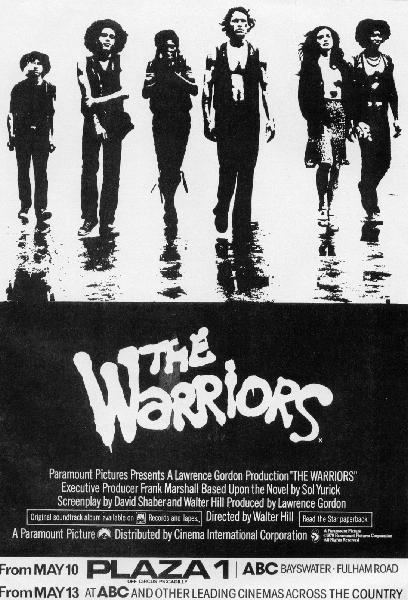
Also, who out there remembers the late-70’s trash classic The Warriors? Come on, don’t be ashamed to admit it; I know a lot of you have seen and loved it. In fact, maybe too many people saw and loved it. It obviously had an impact completely out of proportion to the amount of money spent filming it, or skill spent writing the dialog. Marion Jones did some commercials based on the DJ character a few years back, Twisted Sister mocked its final confrontation scene at the beginning of one of their albums, and Shaq can’t ever speak in front of a crowd without mimicking Cyrus’ booming call to the gangland armies: “CAN YOU DIG IT?”

For those who suffered through deprived childhoods (or weren’t old enough to be watching B-movies twenty-five years ago), the plot of the movie was pretty simple. There’s a gangland rally somewhere in the Bronx, where each of 100 different gangs have sent 9 delegates each to form a gangland army under the leadership of the charismatic and legendary Cyrus, leader of the Grammercy Riffs, New York’s biggest and most feared gang. The idea is that, with well-coordinated army of street-tested kids 60,000 strong, Cyrus and his people can conquer Manhattan (which, as Cyrus points out, is protected by only 20,000 cops)

But, just as Cyrus is ready to lead the mighty and poorly-dressed army to the promised land, tragedy strikes. At the climax of his speech he’s murdered. The murder is committed by Luther, the psychotic leader of the Rogues, but for reasons that have never been clear to me, he is able to shift suspicion to the Warriors, one of the gangs in attendance. The other gangs are outraged and turn on the Warriors, whose leader is murdered right there. The rest of them, though, manage to escape the rally.

They start to head back to their home base at Coney Island, but by now word is out about what happened in the Park, and every gang in the city is after them for killing Cyrus; and no sooner do they escape the territory of one gang than they find themselves under attack from another. And they can’t hide, ‘cause there’s a DJ (we never see anything of her but her mouth) announcing their progress across the city, letting everyone know exactly where they are and dedicating songs to them such as “Nowhere To Run.” So, it’s kind of like the Odyssey, only without ships and, you know, rather than Greek heroes there’s a lot of Afros and denim jackets.

And the gangs they meet! What a bizarre and well-imagined bunch of hooligans! Everyone’s favorites, of course, were the Furies, a bunch that dressed in Yankee uniforms and garish face paint, and (as you would expect) assaulted their enemies with baseball bats. The scene where the Warriors beat the hell out of the Furies with their own stolen bats is a classic of the genre (if, in fact, there is a genre associated with this movie). Also memorable are the Lizzies, an all-girl gang who bring the boys into their hideout under the pretense of hiding (and seducing) them, only to turn on them once they’ve got them off the street. And, of course, the Orphans, the gang made up of kids no other gang wants, whose only uniform is matching pea-green T-shirts and who weren’t even invited to Cyrus’ rally. The main cool thing about them is that Mercy (Deborah Van Valkenburgh, who also just appeared as Casey in The Devil's Rejects), one of the gang's girls, leaves them and joins the Warriors. Doesn't seem like the best time to do that to me, but hey, what are you gonna do? Anyway, I always thought if I had a daughter I'd name her Mercy, in honor of this movie (I tried to talk Pancho into this with his older daughter, but he wouldn't do it).

Between encounters with these folks, the Warriors meet a host of spectacularly-dressed but screen-time-challenged gangs such as the Boppers (my favorite outfits, but I always have loved purple silk). The Boppers' name, actually, kinda screws up the plot, since the DJ calls all the gangs looking for the Warrior "boppers." Still, cool outfits. If I was in New York in 1979 (well, and if I was black), I'd have wanted to join them. Pancho digs the Punks, roller-skating freaks who ambush the Warriors in a subway restroom. They seem to like stripes and overalls; kinda geeky, but it's a damn good fight scene. Finally of course there are the Rogues, pursuing the Warriors across the city and looking like they came fresh from a Guns & Roses video audition. When the Warriors finally make it back to Coney Island, it’s the Rogues who first flush them out, with Luther banging glass bottles together on his fingers and chanting, “Warriors…come out to play…” in a wail that gets gradually higher more ear-splitting the longer he does it.

And then in the last scene, the Warriors emerge from combat with the Rogues to find themselves alone on the beach, staring down every gang in New York. I’m telling you, it’s a classic. As the New York Times said in the original 1979 film review: “The film is as handsome to watch as it is preposterous to listen to, full of gorgeous nocturnal city images that splash blaring neon colors against filthy, rain-slicked gray. (Director Walter Hill) uses subways, jukeboxes, spectacularly eerie costumes and deserted streets to create a stark yet extravagant visual style, and a grimy little world in which everything looks curiously brand-new.”

If you’ve managed to miss it this long, go rent it immediately. And if you’ve seen it before, wipe off the dust and watch it again, ‘cause I’ve got some crazy news for ya. Rockstar Games, the folks who did Grand Theft Auto, are coming out with a Warriors game for the PS2 and the Xbox. Now, I don’t have either of those game platforms, but I’m still getting that game, just to have it. If you’re a friend of mine and I find out you’ve got a PS2, be ready for me to start bugging you to invite me over for game night.

I’ve seen the previews at GameSpot, and it looks really good. The thing that makes me happiest, of course, is that the DJ is still sending out waves of evildoers after our heroes…the game wouldn’t work without her. In fact, all the characters from the movie are there, and they did a real good job with the meshes and the voices. Check out the game's website. Also, action figures are being released, if you can believe that. So, basically, this is the happiest day of my life, I’m gonna go bliss out for a while. Will write an actual post tomorrow or something.

14 October 2005

God, King, and Country

Okay, I’m not gonna spend too much time on this because it’s all over the news and I don’t know that there’s much I can say about it that hasn’t already been said (and I keep saying this isn’t a political blog), but I can’t let it pass without saying something.
For those of you who live in caves, Senator John McCain has added an amendment to the Defense Department Appropriations bill to eliminate the already illegal practice of torturing POWs held by American forces. McCain, himself a former POW and victim of abuse by the Vietnamese (a fact that the draft-dodger Bush used against him in the 2000 campaign, saying that McCain’s experiences at the “Hanoi Hilton” made him psychologically unfit for command) spoke eloquently on the Senate floor when arguing for his amendment: “Many of my comrades were subjected to very cruel, very inhumane and degrading treatment, a few of them even unto death. But every one of us—every single one of us—knew and took great strength from the belief that we were different from our enemies.”
Senators from both parties flocked to McCain. The vote in the Senate was 90-9. If you’re interested in knowing which bloodthirsty sons of bitches voted against it, they were: Wayne Allard of Colorado, Christopher Bond of Missouri, Tom Coburn of Oklahoma, Thad Cochran of Mississippi, John Cornyn of Texas, Jim Inhofe of Oklahoma, Pat Roberts of Kansas, Jeff Sessions of Alabama, and Ted Stevens of Alaska. I didn't include which party they belong to because thye all belong to the same party and I'm betting you can guess which one.
However, regardless of those nine, the President’s own party supported the measure overwhelmingly. 46 of them, including many who usually condone whatever ugliness the Administration can concoct (such as Bill Frist and Virginia's own George Allen), voted for the bill. It had broad bi-partisan as well as public support, which is beside the fact that it's clearly the right thing to do. So, of course, Bush immediately threatened to veto it.
In other words, this President (who in large part owes his job to the mistaken notion that a vote for him supports our troops) is willing to deny much-needed money our already underfunded soldiers in Iraq because he wants to assert the right (which he does not have) to expose prisoners of war (and let’s not forget that, according to the Red Cross, 90% of the inmates at Abu Ghraib turned out to be innocent) to torture, humiliation, and death. I hope that all of you folks out there who voted for him are proud of your boy.
* * * * * * *
There’s been a lot of talk about Harriet Miers recently, as well. I don’t know what the President was thinking here. I mean, if you want to put a super-conservative fundamentalist on the Court, that’s one thing. I can also see that, if you’re going to do that, it’s a good idea to pick someone whose personal views aren’t that widely known, because most of the country isn’t as crazy right-wing fundamentalist as the President, or as his nominee is said (in some quarters) to be. But if you’re going to do that, you have to pick someone who is so over-the-top qualified for the job that her credibility can’t be questioned without her accuser himself becoming a posterboy for partisan politics.
So, instead of doing that, Bush picks a completely unqualified person for the seat, assuring that there will be a hail of questions about competence from both sides, weakening the position of the nominee before her views are even an issue.
And then, before that’s even remotely under control, he leaks her ultra-conservative leanings, thus guaranteeing that both the left and the right will oppose the nomination. I mean, WHAT?
I’ll tell you the truth, though. What Ms. Miers believes isn’t that important to me right now. I’m bothered more about her writing.
David Brooks wrote a piece for the Times about the column Ms. Miers used to write for the Texas Bar Journal. The quotations he includes in his story (which you can read here) are pretty horrific, but not for political reasons. They’re just terrible, bad in every aesthetic way possible. This is a bigger problem than is at first glance apparent. As Brooks writes:
I don't know if by mere quotation I can fully convey the relentless march of vapid abstractions that mark Miers's prose. Nearly every idea is vague and depersonalized. Nearly every debatable point is elided. It's not that Miers didn't attempt to tackle interesting subjects. She wrote about unequal access to the justice system, about the under-representation of minorities in the law and about whether pro bono work should be mandatory. But she presents no arguments or ideas, except the repetition of the bromide that bad things can be eliminated if people of good will come together to eliminate bad things.
Or as she puts it, "There is always a necessity to tend to a myriad of responsibilities on a number of cases as well as matters not directly related to the practice of law." And yet, "Disciplining ourselves to provide the opportunity for thought and analysis has to rise again to a high priority."
I’m not Shakespeare myself, of course, but I write better than that (and, of course, I haven’t been nominated to a lifetime position on the highest court in the land). So forget how conservative she is. The question isn’t what she thinks, but rather whether she thinks.
No, that’s unfair. People who know her report that she’s an intelligent woman, and I’m willing to believe that. After all, one can’t rise to be the president of the state Bar, even in Texas, without intelligence. But, as Brooks (himself a conservative) says, “Throw aside ideology. Surely the threshold skill required of a Supreme Court justice is the ability to write clearly and argue incisively. Miers's columns provide no evidence of that.”
We’ve given Bush a pretty free ride so far, for the most part, but nominating Justices is the most important thing a President does outside of war (which, you know, don’t get me started). He owes his country a serious nominee, and since he doesn’t respect that obligation, we owe it to ourselves to hold him to it.
Also, Brooks makes a good point about the friction between conservatives and Republicans, but we’ll have to go into that later. I have too much to say tonight.
* * * * * * *
I owe the Dyspraxic Fundamentalist a response from last week, and I’d like first to apologize for taking so long to get back to it. Last week was kinda crazy. Anyway, I want to address a couple of things he wrote to me.
First, he objects to my characterization of St. Paul as “anti-intellectual.” He writes: “Please remember that he was higly (sic) educated, knowledgable (sic) about the Scriptures of the Hebrews, the philosophy of the Greeks and the traditions of the Orient.” So his objection is that, as an educated man, Paul couldn’t have been anti-intellectual. This argument is fallacious for three reasons:
1) There is no evidence that Paul was particularly well-educated. According to tradition, he had been taught by Gamaliel, a Pharisee. This would explain his encyclopedic knowledge of the Jewish Scriptures, but lack of training in any other intellectual field. Paul was a tent-maker by trade until becoming an apostle; this is not a trade that requires any education. And though Paul could speak and write Greek fluently, scholars report that his style, though emotionally compelling, was merely “competent” and never achieved any polish. Certainly he had little or no education in even the rudiments of Greek philosophy; even his grammar was stilted. There’s little biographical information about Paul, and what we do have is unreliable, but what evidence there is indicates a man of some, but not extensive, education.
2) Even if Paul could be shown to have had the first-century equivalent of a Ph.D. from Columbia, that in itself would prove nothing. Educated people are frequently anti-intellectual. My President, for example, has a degree from Yale. Insert your own joke here.
3) Finally, beyond these somewhat abstract theories about his education, the content of Paul’s writing itself declares him anti-intellectual. Maybe it was a reaction to the way he was laughed out of Athens when his theological arguments couldn’t stand up to the questions of the Greek thinkers…Paul seems to have been a man for holding grudges. Whatever the reason, Paul very early distanced Christian belief from reason and logic. If I may include an excerpt from Charles Freeman’s wonderful book, The Closing of the Western Mind:

The idea of being open to “faith” is a powerful one; the longing to surrender the self to another who can provide certainty is an enduring part of the human psyche. However, for those who believe in the importance of using reason to define the truth, this surrender must raise concerns. Plato, for instance, specifically condemned “faith” as a means of finding the truth; for him the only secure way of understanding the immaterial world was through the use of reason…Although there is no evidence that Paul knew of Plato’s thought, we can assume that he realized that his concept of “faith” was vulnerable when set against the mainstream of the Greek intellectual tradition. As we have seen, he may have been unsettled by his confrontation with the pagan philosophers in Athens. His response was to hit back with highly emotional rhetoric, the only weapon to hand. So for Paul it is not only the Law that has been superseded by the coming of Christ, it is the concept of rational argument, the core of the Greek intellectual achievement itself. “The more they (non-Christians) called themselves philosophers,” he tells the Romans (I:21-22), “the more stupid they grew…they made nonsense out of logic and their empty minds were darkened.”…There is something of the mystic in Paul’s disregard of logic (and a paradox in the way he uses his considerable rhetorical skills to attack the very intellectual tradition of which logic was a part). This disregard had unfortunate consequences. As Paul’s writings came to be seen as authoritative, it became a mark of the committed Christian to be able to reject rational thought, and even the evidence of empirical experience. Christians would often pride themselves on their lack of education, associating independent philosophical thinking with the sin of pride….the Greek intellectual tradition was to be increasingly stifled by the churches. So here are the roots of the conflict between religion and science that still pervades debates on Christianity to this day. By proposing that Christian faith (which exists in the world of muthos) might contain “truths” superior to those achieved by rational argument (logoi), it was Paul, perhaps unwittingly in that he appears to have known virtually nothing of the Greek philosophical tradition he condemned, who declared the war and prepared the battlefield.

I recemmend the book for a fuller treatment of the subject; space is somewhat limited here.
So, actually, when I call Paul an anti-intellectual, I’m doing him a disservice. He was, in fact, the great greasy granddaddy of all anti-intellectuals. His opposition to logic, reason, and the philosophic tradition is marked. And given that that tradition, rediscovered by the Renaissance Humanists, is the basis of Western society; given that it gave birth to our modern world with its vast scientific achievements and tremendous political freedom and high quality of life; given also that these things were accomplished over the objections of Paul's church; given those things, Paul’s opposition to it seems telling, as well as tragic.
I include this because I wanted to respond to the DR’s statement about Paul, but it is, again, outside the scope of my original argument, to which I want to return now (for those who missed it, my argument is stated in the post The Wrath of God, and the beginning of my discussion with the DR is on the comments page of that post). Touching on my original argument, the DR writes: “Your theological argument is an argument from values. You insist that your moral values are correct and right, but who says so? Suppose it is your opinion that gambling is a really bad thing. Who cares? I might want to gamble and think it is great.”
Okay, let me say first that, in actual point of fact, gambling is in my opinion a really bad thing, in that I’ve seen it destroy many people. On the other hand, I have no moral objection to drinking or drugs, and I’ve known a lot of junkies and alcoholics and seen a lot of people destroyed by substance abuse. My personal feeling is just that, a personal feeling.
I understand that the fact that I dislike gambling doesn’t mean that you shouldn’t be allowed to do it, and I would never support a law banning gambling (though lotteries bother me, because I don’t see why the state should actively promote gambling). For that matter, I'd legalize drugs across the board, and prostitution as well.
But understand, what we’re talking about here is wholesale murder and mass suffering. It isn’t my opinion that these things are wrong; that’s as close to a universally accepted moral truth as we, as human beings, are ever likely to get. My problem with God certainly is, as you say, moral, but don’t downplay the depths of immorality that I’m accusing God of; a croupier or a gigolo or a junkie has nothing on God when it comes to sin. The God of the fundamentalists endorses genocide, for Christ’s sake. The God of the fundamentalists destroys entire cities, entire cultures, to weed out a few bad eggs. Moral values may change from place to place and from person to person, but can’t we all agree that genocide is wrong?
Further on, he says: “You say that the God of the Bible is not worth worshipping. Of course you would; the God of the Bible demands what you do not want to give, hence you reject Him…You do not have an intellectual problem, you have a moral problem. God has revealed His nature and you do not like it, so you reject all the evidence for God.”
The bit about rejecting all evidence for God is beside the point, of course, because my argument stipulates that the Biblical God does exist, so we’ll pass that one. More important within the context of this discussion is the assertion that I reject this God because he wants what I do not want to give.
That isn’t what I said. I don’t reject God because he won’t let me do what I want to do. If it was only a question of God telling me I couldn’t whore around or kill or beat people or bliss out on heroin, then there wouldn’t be a problem, because I don’t whore around or kill or beat people or bliss out on heroin (anymore—you can get too old for that stuff). I don’t reject God because he wants me to live a certain way and living that way is hard. I reject him because he’s cruel and wicked. I reject him because I find him morally inferior to myself. I reject him, not because I’m unwilling to be held to a higher standard, but because I reject the lower standard he holds himself to, the personality of a spoiled and vicious child that his putative Word depicts.
I say again: an all-powerful being who could punish the guilty while sparing the innocent but refuses to do so deserves not worship but condemnation. If you could show me a just and loving God, that would be one thing, but the God of the fundamentalists ain’t it.
There is, as Freeman points out, something in the human psyche that longs for the certainty and security of a divine father and the assurance of eternal life. In the words of my beloved Voltaire, “If God did not exist, it would be necessary to invent him.” I don’t know that I’m any different from anyone else in this regard. I have moments of lonliness and despair, when a faith that everything will ultimately work out for the best would be very comforting. But I won’t sacrifice my love of justice and compassion for that comfort.
Give me a God that doesn’t offend my conscience. Then we’ll talk.
* * * * * * *
So, I was out drinking last night and ran into a friend from the English department, who wishes to remain nameless (she doesn’t even want a pseudonym, because she’s afraid I'll pick one that will reflect badly on her). We talked for quite a bit, the conversation ranging from books about baseball to hippie festivals to Dr. Johnson and Shakespeare.
She was there when I finished my first pitcher of beer and ordered my second. This prompted her to ask what I get out of drinking, that I drink so much. And that’s a damn good question. The quick, easy answer is that we all do this, everyone in my family. We’re all either tee-totallers or alcoholics, with the exception of my brother (who has the sort of self-discipline you usually only find in Shaolin monks). And it’s bigger than alcohol, too; we really just have addictive personalities. We are not moderate people, and the ones who aren’t alcoholics or junkies are gambling addicts or religious fanatics or gluttons or something along those lines.
So, I can claim genetics as the culprit, and for the most part I’m perfectly comfortable with that explanation. The real answer, though, is more involved.
I told her briefly about Christine, a friend back home during the Blackout Years and one of the very finest people I’ve ever known. She was a psychology major, and decided to use me as the subject of her thesis or keystone or whatever it is you have to do before they’ll let you graduate.
So of course she interviewed me on several occasions, and in one of these interviews she asked the question point-blank: “Why do you drink so much? What does it do for you that you must do it this much?”
I didn’t want to give her a simple answer that wouldn’t be true. So I went off and wrote her a ten- or twelve-page paper, outlining the conscious reasons for my drinking (the biological ones are another matter; you’d have to ask a doctor). I don’t, unfortunately, have that paper anymore. I didn’t make copies, and she never gave it back to me. If you really want it, you could ask her. Last I heard, she was living in Boulder, Colorado. Look her up. Hi from me.
Anyway, that paper was the answer, if there is one. And it’s too long an answer for a casual converstation in a bar, and it’s also too long to include in this already over-long post.
If anyone’s interested, maybe I’ll try to reconstruct that paper over the next few days and give it a post of its own. But really, the best answer to the question is this: if you aren’t an alcoholic, I don’t know that there’s any way I can make you understand. Still, I’ve been writing this from the beginning (well, at least at the beginning) so that outsiders could get a glimpse into our lives. So, I’ll make an effort to quantify all of this for you non-alcoholics. I hope it’ll make sense when it’s done.
* * * * * * *
Also, my English department friend and I talked about this blog. She believes that I use this as an outlet for a self-destructive impulse. That could be true. Probably every alcoholic feels that impulse, and I know I’ve always felt drawn to people in the grip of it. For exampe, I loved Mills and April (the people responsible for my going to California, and for the Dave Matthews debacle as well) as much as I’ve ever loved anyone. Mills was a band-mate, a great guitarist with a natural feel for the perfect riff, plus which his middle name was "Godly," which I always loved. April was maybe the smartest person I've ever known (present company excluded, of course), a talented writer who now makes an excellent living as a globe-hopping freelance writer, and also one of the genuine loves of my life. And let me tell you about these two: it's said that easygoing people skate through life, and if that's true, then Mills and April were definitely traveling in bumper cars. My other friends and I used to discuss their apparent death wish at great length; probably similar conversations were had about me, as well.
Anyway, yeah, maybe. I don’t know where the impulse comes from, if it causes or is caused by the alcoholism, or is identical to or completely separate from it, but it’s definitely there. And maybe it does manifest itself in this blog. Certainly I’ve damaged myself with this thing, losing a home and most of my friends because of it. And I’ve probably been too open on these pages, put too much of myself on them. I'm quite sure, for example, that if I ever run for public office I’ll be haunted by the things I’ve written here.
But I don’t see this blog as an instrument of self-destruction. Quite the contrary, in fact; to me it feels redemptive. My friend asked me if I thought of this as therapy, and maybe that’s part of it. But mostly it’s just that this is where I am who I am, where I say what I think and feel. Most of us spend our whole lives not being listened to, and this blog gives me the opportunity to be heard, or at least the illusion that people are hearing me. This is where I speak from the mountaintop, and if mine is not the voice for these ears, well, that’s okay. It’s still MY voice.

10 October 2005

Hang On A Minute

Well, it’s been a hell of a long week. I spent every free minute all week long compiling the research I’ve done for the movie, and then went to the library last night to try to turn it all into one long but coherent report. Unfortunately, the computers crashed twice last night, and I didn’t get the damn thing finished, even though I was there ‘til 5:00 this morning. So, I’ve gotta go back and do it again, tonight and tomorrow.
As a result, this isn’t gonna be a terribly long post. I mostly just didn’t want you folks to get bored in my absence, so I thought I’d better come ‘round and say hello. And, since I haven’t done anything but work this week, there wouldn’t be much to report if I did have the time.
However, I did want to gloat, just real quick. Tom DeLay sucks balls.
Also, to remind the guy I’m having the theological semi-debate with: you’re gonna have to gimme a couple more days. Sorry.

03 October 2005

The Endangered Pleasure of Smoking

I am extremely sorry to say that I did not write this beautiful piece of prose, but it’s been a favorite for years, and I wanted to share it with all of you. So enjoy it, and if you like this essay, you can buy the book it came from at Amazon.com, and you can link directly to that page by clicking the title above.
* * * * * * *
Now that we’ve all been told half to death of the medical horrors lying in wait for smokers, those who were never lured into the filthy habit gaze in slack-jawed amazement at those who were: How could we possible have done such a disgusting and dangerous thing? Whatever possessed us? And not just once, mind you, but over and over, for years. Decades. In heaven’s name, why?
Well, it’s time somebody explained. No we weren’t attempting suicide, or deliberately trying to stunt our newborn children or poison the bystanders. We did it because it was fun. It felt good. It good like scratching an itch, or stretching, or biting a grain of caviar, or having your back rubbed, or taking off tight shoes.
There, I said it.
Cigarettes tasted good. Their flavor mixed happily with other tastes; apples, cold beer, after-dinner coffee.
They were sexy. The shared cigarette. The compelling gaze half masked by lazy bluish veils of smoke. The courtship gesture of the smoothly produced flame for her waiting cigarette, with an exchange of meaningful looks. The sensual implication of lighting someone’s cigarette between one’s own lips and then, slowly, handing it over. The sweet camaraderie of the after-sex cigarettes, the pair of identical small orange lights signaling each other like fireflies in the dark bedroom, their glow a wordless message of satisfaction that replaced speech, compliments, promises. It softened the abrupt departures of both parties into separate sleep; “I am here,” it said, and “So am I.”
The passing of cigarettes leaves all phases of romance impoverished.
One cigarette was worth a thousand words. The infinite inflections of producing and lighting it, inhaling and exhaling, spoke volumes about personality, mood, intention. Many famous actors owed their reputations to cigarette technique. The half-smoked butt flung down, or flicked over the shoulder, or ground out very carefully on the sole of the boot meant that the time for negotiation was over and the action would begin. The cigarette pause, in which the protagonist, halfway through a sentence or before answering a question, takes out and lights a cigarette, repays years of study by cinema buffs.
Men, notoriously shy of personal conversation, relied heavily on them. A group of men could gather and stand around and smoke together, enjoying each other’s company, without the need of speech. Now smokeless, they’re left just standing there like an arrangement of stones, hands dangling, until embarrassment breaks up the group.
The tobacco offer was a gesture of peace, as it was among American Indians. One took out a cigarette, then offered the pack to another, saying, “Cigarette?” The other might accept, putting him or her subtly in the first person’s debt and boding well for the upcoming transaction, or refuse, implying unwillingness to cooperate; coolness if not downright hostility.
The cigarette relieved tension, and became the traditional last rite and final perk before the firing squad.
It gave us a chance to think. Faced with a sudden decision or unexpected proposal or proposition, it delayed response by a crucial thirty seconds or so while we extracted one from pack or case, considered it, lit up, and thoughtfully exhaled.
After the battle, after the surgery or the car accident or the lost child found, the cigarette clutched in shaking hands gentled down our panic in its silken cradle of smoke.
Cigarettes were a social crutch, offering shy people something to do with their hands, along with welcome moments when they weren’t expected to talk.
They were the seal of a job accomplished, especially a physical job. Having finished painting the porch furniture or planting the daylilies or waxing the car or scaling a cliff, we stood back for a long, satisfying moment to admire what we’d done and smoke the cigarette of reward.
They gave us something to fidget with while waiting for the phone to ring, or the bus to come, or the baby to be born. Something to do during those inevitable blank spots in the conversation. Something to distract the whisper of hunger when we were far from lunch. Tic-Tacs and worry beads are not the same.
For the last smokers, as their numbers dwindled the private-club atmosphere strengthened. The gallant little band, half frozen in an alley behind the office, half-choked in a sealed hallway or smoking car, huddled under the marquee at intermission, or meeting by chance, led by the scent of smoke, in a damp, foggy garden halfway through a dinner party, were immediate companions in sin. Wordlessly, they shared mixed feelings of shame at their bondage, and a kind of defiant pride in their stubbornness.
The last smokers know the joy of walking into someone’s office after a long, smoke-free, corporate day and inhaling the sudden friendly reek of ashtray: liberty at last.
They recognize each other by smell. Like Henry V, a smoker meeting other smokers “bids them good morrow with a modest smile,/ And calls them brothers, friends and countrymen.”
Besides the human comradeship, the cigarettes themselves were company. All longtime smokers who have given up report the pervasive sadness of their absence, as of the death of a friend. The little white companions of our whole adult lives, more faithful and durable than many a spouse, are missing from our pockets, banished from our desks and bedside tables. We feel abandoned and diminished.
If you had to ask, it’s hard to explain. They’re no longer a legitimate pleasure, but they were a pleasure once. We may have been stupid to smoke, but we didn’t smoke from sheer stupidity; we smoked because we liked it.
--Barbara Holland

01 October 2005

The Wrath of God

So, the past few days have been really good for those of us who enjoy watching people making complete assholes of themselves publicly. Bill Bennett, for example (and there’s no one I love to pick on more than Bill Bennett, whose picture I include courtesy of the Washington Post) had a good one on his radio show the other day, when he pointed out that if we abort all black fetuses we'll have a lower crime rate. The actual quote, if you're interested, was: “I do know that it's true that if you wanted to reduce crime, you could—if that were your sole purpose, you could abort every black baby in this country, and your crime rate would go down.”
Of course, Bennett doesn’t actually want to do that, and said at the time that it would be immoral: “That would be an impossible, ridiculous, and morally reprehensible thing to do, but your crime rate would go down.” What he means by that second statement is that abortion is immoral, even if it’s black babies you’re killing. Which, given his background, is pretty good for him, if you think about it.
Anyway, his main point might well be correct. I got no numbers on this, but I'm willing to believe that, if you abort all black fetuses, the crime rate will go down. It will also probably go down if you abort all white fetuses. Or all left-handed fetuses. Or all blue-eyed fetuses. It seems likely to me that the complete removal of any statistically significant group will reduce the crime rate. It just happened that Bennett decided specifically to mention black folks. Dumb luck, that, don’t you think? Anyway, with his later explanation, at least we know that his religious extremism is stronger than his racism. Sure, eliminating black folks from the population before they're born would make the country a better place, but we can't do it 'cause abortion is just plain wrong. Doesn’t he deserve credit for that?
I’ve gotten into trouble recently for being sarcastic on this blog. Apparently my sarcasm doesn’t transfer well to print, and folks have trouble telling when I’m being sarcastic. So, everyone, that last paragraph was SARCASM, okay? Fucking sarcasm. Grow up.
* * * * * * *
Anyway, Bennett hasn’t been the only froot-loop in the news the past couple of days. I wrote before about the loopy-loos who think that Katrina was God’s judgment for our wickedness. Well, a new voice has weighed into this debate, and it’s a little more worrisome than the others; you see, this guy is an actual elected official in Alabama, a state senator named Hank Erwin.
Here’s what he said in his column the other day about my beautiful city and the judgment of his God:

New Orleans and the Mississippi Gulf Coast have always been known for gambling, sin and wickedness...It is the kind of behavior that ultimately brings the judgment of God… Warnings year after year by godly evangelists and preachers went unheeded. So why were we surprised when finally the hand of judgment fell? Sadly, innocents suffered along with the guilty. Sin always brings suffering to good people as well as the bad…. We all need to embrace godliness and churchgoing and good, godly living, and we can get divine protection for that point…The Lord is sending appeals to us. As harsh as it may sound, those hurricanes do say that God is real, and we have to realize sin has consequences… If you are believer and read the Bible, you know sin has judgment. New Orleans has always been known for sin... The wages of sin is death.

Now, I’m used to random wackos saying this, and even well-known wackos like Pat Robertson and Jerry Falwell. But this guy actually has the power to make laws! Does that strike no one else as scary? And enough Alabamans voted for him for him to win this office! That’s even scarier!
I don’t know many Alabamans personally, and I don’t hold them in contempt or anything, but this is looking like a state that might need some therapy.
* * * * * * *
Now, I’m gonna come back to this idiot in a bit, but first, I’m gonna set the parameters of the argument I’m about to make, so bear with me.
I’ve mentioned before in these pages that arguments go on frequently between my friends over whether or not there’s a God. I usually avoid this argument. It seems clear to me that the Universe was formed by something very like the Big Bang (and we’re learning more about this all the time), and that life on this planet evolved from very simple life forms into the variety we see around us today. Neither of those beliefs is inconsistent with the idea of a higher intelligence that originally set everything in motion, and since there’s no reason to believe that this Divine Creator either does or does not exist, I don’t think about it very much.
Any understanding that I adopt of the origin of the Universe requires me to believe something logically (if not physically) impossible. If I believe in one of the variations on Big Bang theory, then I must believe that, at some point in the distant past, there was no space or time and all the matter in the Universe was either crammed together in a really tight ball or spontaneously created out of nothing. That offends the experience of my entire life, where I’ve always found that nothing comes of nothing, that every effect has a cause.
On the other hand, if I believe in a Divine Creator, then I not only have to believe that all matter in the Universe was created out of nothing, but also that a superior being, whose nature runs directly counter to everything I’ve known and observed about the world around me, existed before this Big Bang, and was the one who set the whole messy operation in motion. The problem with this is that there was no “before” the Big Bang. Time just didn’t exist. Neither did space, which means that prior to the Big Bang, there was no place for this superior being to be.
So, to believe in the Big Bang, I have to believe in something that doesn’t really make sense to me. To believe in divine creation, I have to believe this same thing, plus I have to add something else to believe that doesn’t really make sense to me. Why am I going to make this more complicated than it already is? Why believe two apparently impossible things, instead of one?
It is inconvenient to believe in a divine creator; therefore, I don’t. I have no strong opinion; I just don’t believe. If you do, hey, whatever helps you sleep at night.
* * * * * * *
This is a scientific (or at least semi-scientific) discussion here, and has nothing to do with fundamentalism. The fundamentalists are just plain wrong. Demonstrably, pathetically, and wickedly wrong. God did not create the Universe in six days six thousand years ago. He didn’t make Adam out of mud, or Eve out of Adam’s rib, and childbirth is not painful nor agricultural work laborious because the two of them ate fruit from a tree. And by the way, at no time was the Earth suspended in a great bubble surrounded by an infinite, extra-terrestrial sea, which bubble God opened up to destroy the world with a great flood, so stop looking for the damned Ark. None of that is true, okay? Also, there’s no Easter Bunny.
So, when I say that I don’t know whether there is or was a Divine Creator, I mean exactly that. But if there is a Divine Creator, I can absolutely promise you that the God of the Bible ain’t it, or is at least a very poor artist’s conception of the original.
Still, even this isn’t the point I’m making here, to Senator Erwin and all the emotionally crippled lunatics who want to impose Sharia (or its Christian equivalent) on us all because God might destroy our cities. Because these people don’t care about science. You cannot win an argument with them on scientific, or even logical, grounds, because they will refuse to argue scientifically or logically. It’s a tradition passed down from St. Paul, who though intelligent lacked the rhetorical education necessary for his arguments to prevail against the great thinkers of his day, the students of the Greek philosophical tradition that was still strong in the first century; so he decided that arguments were inferior to faith, and for some reason lots of people believed him. They still do.
You can show them all the evidence from biogenetics and cosmology, the chain of fossil evidence running from the primordial soup to the earliest man, the background radiation pictures from the COBE satellite, and they’ll disregard it. They will simply refuse to believe the evidence. So I won’t argue against them with science. I’m perfectly prepared to have a theological argument with them, and at the core of that argument is this statement: YOUR GOD IS NOT WORTH WORSHIPPING. Senator Erwin, Mr. Robertson, you’ve picked a bad God. Even if you could conclusively prove that your God is real and that the Bible is His word, He doesn’t deserve to be worshipped.
The record of reckless cruelty exhibited by God in the Bible is way too long to get into here, but even Senator Erwin’s own statement shows a God unworthy of adoration. Go back up a bit and reread what Erwin said. I particularly want this line to sink in: “Sadly, innocents suffered along with the guilty. Sin always brings suffering to good people as well as the bad.”
Now, our entire criminal justice system was built on the idea that it was better to let ten guilty men go free than to punish one innocent man. It was an article of faith with the Founders, and is one of the bedrocks of our Constitution, which is why we have the Fourth, Fifth, and Sixth Amendments. We can’t always manage it, because we’re human beings and therefore fallible; and sometimes we have corrupt people in power who disregard or subvert this idea. Nevertheless, it is the high ideal of our concept of justice, and for the most part we do our best to live up to it.
God, on the other hand, could easily punish the guilty while protecting the innocent. That is part of being omnipotent. He could, for example, just hit all the bad people in New Orleans with heart attacks, or He could miraculously pluck the innocent from the water and divert destruction from their homes. And yet, He doesn’t. It’s not that He’s willing to let the innocent suffer; he is, by Senator Erwin’s own estimation, willfully causing the innocent to suffer. Why should we worship a God that has a less-developed sense of justice and morality than we have?
A God that would destroy an entire city to punish a mere portion of that city’s inhabitants is not worthy of praise. A God that would destroy an entire city to punish a mere portion of that city’s inhabitants deserves condemnation. It’s as simple as that.
The Born-Agains say that the goodness of God is beyond all understanding; that’s because there’s so little of it that it’s hard to draw a representative sample. The wickedness of God, though, is easy to see. In fact, the wickedness of God is pretty much exactly the wickedness of man, only on a grander scale. The God of the Bible is petty, unjust, vengeful, jealous, vicious, cruel, selfish, and murderous. The God of the Bible exhibits behavior we would find unacceptable (if unsurprising) in a small child. He isn’t worthy of worship; He’s a monster. The original monster.
So, the point isn’t whether or not Erwin and others like him are right. The point is that it doesn’t matter. Prove to me that this ugly, unjust God exists. Bring Him here, right now, and my knee will not bow. If my manners prevent me from spitting in His face, it will be better than He deserves.
If I'm going to worship a God, it will be a kind and just God. I can live with one that allows bad things to happen, but not one that intentionally causes pain and suffering and death out of spite. That, frankly, is beneath me, and if He's beneath me, how worthy a God can He be?